Showing posts with label Composting. Show all posts

Friday, July 5, 2019

Update on Compost

New structure, next to the bridge


I first introduced our new compost gully, on the other website, over a month ago. You would have seen it posted on this blog, just yesterday though. I wanted to update, how we're still tweaking the design using more sapling trunks. David installed a teepee structure, to help support the pumpkin vine. It's still growing quite well, during winter. I think the warmth from the compost breaking down, helps.

Thursday, July 4, 2019

Compost gully

June 2008 - first bin


When we started composting on our land, we thought a large standing compost bin, was the way to go. The kind with multiple bays. We built three, out of recycled pallets. It was appealing, because we had the opportunity to make a large batch of compost, in one go. Unfortunately, we weren't generating enough of all the different ingredients to make a substantial batch.

Saturday, March 3, 2018

Autumn assimilates

Autumn is when all that decay, from the end of a long, growing season, gets assimilated, back into the soil. So right now, is the perfect time to consider the aftermath left over, in your garden, after summer.

I have been outside lately, tidying up, and contemplating an idea my mother, inadvertently gave me.


Image source, of an outhouse


It's was based on the story she told me about the old, "outhouse", her father would dig every few years. Once it was completely filled with their family's humanure, another hole would be dug. To which the outhouse would be relocated over - then a tree was planted, on the former hole.

Apparently the best tasting fruit, were always gleaned from the former outhouse, trees. I thought it was a splendid idea of dealing with waste, by moving it around. But I didn't have a compost toilet, as yet - only access to a lot of organic materials. I wanted to be more strategic with them.


After 5 months


I started this pile back in Spring. Why here? It's near our banana circle. The long grass is disguising it's existence, but it's back there. I wanted to protect the bananas from hot winds, and thought a pomegranate would make a good windbreak. Only this location, had horrible, clay soil. It seemed to me, a perfect candidate for a pile of organic matter.

With the flush of spring rain we received (back then) I cut down a lot of grass, weeds, prunings and piled it all here - along with some buckets of kitchen scraps. Then left it over summer. During that time, it's shrunken considerably.


Close up, of older materials


The cooler weather of Autumn, summoned me back to the pile again. Time to clean up, and assimilate all those decaying materials in the garden, where they can do the most good! I had acquired a myriad of of both natural, and processed items, which needed an organic solution.


New additions


We had some brown paper bags, from buying fruit at the local farmers market. We tore them open, and laid them flat, on top of the old compost material.


Pungent!


On top of the bags, went a full bucket of vegetable scraps. Stinky, smelly and perfect for the job of decomposition. No fussing. No turning of older materials. Just dump it all on top! The smell dissipates, quickly.


The "whatever" I had laying around


I also had a couple of buckets of old coffee grounds, and potting mix, that needed rejuvenating. They were completely baked over summer, so too dry and lifeless to use in pots again. But perfect for a pile of compost. The soil microorganisms, will rehydrate them with enough time.


Cardboard


We also had an old cardboard box, groceries were collected in. Lovely carbon for the mix too. It was opened up and flattened, in the same way the bags were.

There ARE specific rules for the perfect pile of compost, but I literally use, whatever's at hand. It gets dumped, like nature would dump it, on TOP of the soil. If I fuss over anything, it's trying to make a carbon sandwich around the wet layers of kitchen scraps and green prunings.


Gleaning fresh materials


I tidied up the grass, growing around the vegetable beds, yesterday - using my trusty, manual, hedge trimmers. I love those, for avoiding petrol smelling clothes, unlike the line trimmer! And all that grass, was destined for my compost pile. I've got mountain-loads to deal with, right now. Can you see it all?


Ready. Set. Decompose!


Grass topped the pile off, and being so green, you can barely notice it's existence now. Perfect camouflage, but in a week or so, it will turn brown again. If you're dutiful enough, especially in autumn, you'll always be adding new material to the pile. My hope is by next spring, I'll have better soil, to start my pomegranate in!

Like the old, "hole in the ground", technique, my forefathers used, there's no reason a compost pile, needs to be in the same location. Maybe if you're limited on space, it makes sense to organise it that way. But if you don't want to turn compost with your back, just leave organic material on top of the soil; for the worms, bugs, larvae and all manner of microorganisms, to deal with it.


Clean and tidy, again, after David mowed


If I was to make a habit of turning compost, I think I'd want to do it, with one of those compost, tumbler bins. We've had a traditional compost pile before, and while I don't have anything against the concept; if I can reduce my workload, I will. I'm glad we don't have to turn the compost, every week, like we used to. Instead, we just have to be strategic, where we want to plant the next tree.

Which is about the only complicated thing, with this strategy - deciding where the next pile will go. Will I have problems with brush turkeys, bush rats and marsupial mice, trying to dissect the pile for a me? Most likely! Which is why it's best, starting, when rains are around. It will ensure the scavengers, have a plentiful supply of food, everywhere.

And if they scratch it up - so be it. They can turn the pile for me. I'll erect a cage around the pomegranate, when it goes into the ground. Which should save my sanity.

Has autumn (or spring - depending where you live) called you back into the garden yet?


Saturday, May 20, 2017

Blooming hardy

Roughly nine months ago, I wrote a post about Carbon Pathways. It's where we cut down a Casurina tree, to rejurvenate an orange, in need of some light and free mulch.


August 2016 - Casurina tree, left


In that post, I explained how we used all of the tree, to mulch various fruit trees, and some roses. I didn't take any photos of the roses at the time, because they looked really pitiful.

We cut the roses right back, as instructed by the nursery we purchased them from. It's meant to stimulate branching and new growth, which we wanted. It's actually meant to be a rose hedge. Maybe one day, it will be?


September 2016


This photo was taken a month after mulching, with the leaves of the Casurina tree. We also used the trunk as a border. This position in the garden, is incredibly harsh. It cops the hot western sun, is on clay and really doesn't receive a lot of attention from us. Certainly not with additional nutrients.

The keys factors to success has been, purchasing the hardiest rose our local nursery could recommend. It's a rose resistant to blackspot, and a lot of the diseases which infect roses, grown in a hot and humid climate. But the second key to success, has been the kind of mulching material we selected.

Aged wood, and woody mulching material, provides the perfect environment for mycelium to grow. Mycelium helps plants take up water and nutrients better, and for longer. Without that structure in the topsoil, everything would be lost via gravity, to the subsoil. So the kind of mulch you choose for your environment, is important too.


September 2017


Still a month after mulching, and the new shoots are really taking off. The front rose is a rugosa rose - closest relative to the wild rose. The original hardy variety. The others in the rear, are a Tiger Rose. Back when we purchased them, they were just known as a Tiger Rose, but now they breed different varieties, with variations on the "Tiger" name.

I'm sure all the Tiger roses, must posses the same tough, disease resistant qualities though. I have not been disappointed with buying these roses. Not one bit. If you have a harsh environment, most traditional roses wouldn't like - look for the wild roses, or any new varieties, sharing the same genes.


April 2017


Four months, after the initial mulching now, and the roses are filing out more. It's autumn, and our roses survived the intense heatwave, we endured last summer. With no additional water or nutrients added by us - other than mulch.

The needle like leaves, of the decaying casurina foliage, was still present, but patches of soil, began to appear though it more. In the above photo, I merely weeded the grasses and weeds, which popped-up in the rose bed and around it, then laid them on the thinner spots of mulch.

I don't worry about unwanted seeds going into the bed. Anything which does pop up, just gets pulled for mulch on the garden bed again. The more I've been doing this, the fewer weeds there are. Plus they are really easy to pull. Although I have to avoid the thorns of the roses!


April 2017


Given this location is such an inhospitable environment, and we just experienced one of the hottest and prolonged summers I've been here (max 45C or 113F), it's remarkable to see how strong and healthy the new growth was, as we entered autumn. It's like we all breathed a collective sigh of relief.

Which highlights, the correct plant choices and mulches, makes it's possible to keep plants alive through extremes. We have that Casurina tree to thank, and why I'm an advocate for growing companion plants in your garden. The kind which can be used as a windbreak, shade enhancer (but not too much shade) and can afford to be sacrificed at the right time, so others, can continue living.


April 2017


That incredible gift to the landscape, hasn't finished giving either. Just as I'd hoped it would, the Casurina tree started re-shooting, from the stump which remained. Being hardy, is an excellent feature to have at our place. I'm looking to get more of these beneficial trees, as a form of long term mulching supply, and even hedging.

We let this Casurina get to a tree size, requiring a chainsaw to cut down. However, a regular pruning should keep it's growth in-check. So you'll still get woody material for mulching, you'll just use a set of pruners more regularly, instead of a chainsaw, several years in.

A word of caution though, if left to grow to it's full potential, it can get to be a big tree. So unless you plan to keep it's growth in-check manually, I would avoid introducing it into a small garden.


May 2017


This is what the rose bed looked like, earlier this month. Healthy, bushy roses, smothered in blooms. This arrangement, is actually positioned on our property boundary. We wanted it to be a living fence, however, I'm not quite sure if we got our spacing right.

Maybe it just needs to fill out some more?


In the distance


I was really chuffed to see our neighbours planted a pair of Jacaranda trees, near our rose boundary. I was a little concerned at first, they might shade out the roses - but really, they'll be benefiting them. They will help shade the hot afternoon sun, while still getting access to sunlight, for the rest of the day.

And Jacaranda trees, don't tend to have thick foliage either. So a nice, dappled shade. I'm imagining the bright purple flowers of the Jacaranda trees, contrasting against the hot pink, and white - later turning yellow, of the roses. I'm so glad our neighbours put these trees in.


Blooming hardy


I don't believe you should have to go without roses, in a challenging environment. These magnificent blooms, subsist on natural rainfall alone. And it can be such a long time between drinks, too. Just select a hardy cultivar, and the kind of mulching material that will attract mycelium to the soil. Also, don't forget a companion plant of some variety.

You might not always want to go out and buy mulch for your roses. I find straw breaks down too quickly in our climate. So a companion plant with some woody material, that takes longer to break down is beneficial. I can recommend the Casurina tree, but for smaller places, the humble wormwood too.

The benefit of having roses, are beauty, delicious fragrance, bee food, habitat for predatory insects near our vegetable garden, a living fence, but also connection with our neighbours. Whenever they pull into their long driveway, and check the mail, they get to see roses. That connection, possibly encouraged them to see what was possible, so planted their own trees with attractive blooms.


 White turns yellow, as the blooms mature


So now we've created a community of biological lifeforms, for a more alluring  outlook, than just brown grass. I'm sure this area will only get more beautiful, as long as we continue to apply the right mulch.

If you want to get this rose, I can highly recommend the Brindabella Nursery in Highfields, if you're a local. They have really healthy stock, and know how to select the right rose, for your environment. But I also think they can be mail ordered to other States. Wild roses, like the rugosa rose, tend to be available, in most locations (here and abroad) too.

I'm looking forward to the rose hips, that will develop into winter. They are full of vitamin C. But that's only if the kangaroos don't eat them all, first!


Sunday, August 7, 2016

Carbon pathways

So here's something I've learned, which you simply must do if you have land, or access to a LOT of plant material. You need to put all that carbon back into your soil, in order for it to improve the soil. Sometimes, burning it off, can help put charcoal back into the soil, which is actually beneficial. You don't need much charcoal though. You certainly don't need it every year. Most of the time, you want to place the majority of your carbon material, onto, or back into the soil.

Think of it as rewarding the soil microbes for growing anything on your land in the first place. You can do this by using livestock, recycling plant material through their dung. Or you can use the plant material itself. Never remove from your landscape, what it had the wherewithal to produce. That's like robbing your own bank account. You'll eventually spend the land itself.


 Orange blossoms - looks to be an abundant harvest


Which is what carbon pathways are all about. It's a permaculture term, which plans to design excess carbon into the landscape, and recycles it back into the soil. Being cyclical in nature, it's designed to continue giving, indefinitely.

I'm constantly dealing with carbon in our garden, and I probably haven't given it as much credence as I should. At least from it's point of origin. You see, we have an abundance of eucalyptus, acacias and ironbark trees, which David and I are constantly having to deal with. We should have put them to work as a resource, a lot sooner than we have. At least now though, we see it's an asset to be utilised.

When David was taking down the old trellis recently, for example, I did some more mulching of our Leng Navel. It's a different tree to the Washington Navel, I gave the same treatment to a few months ago.


Leng Navel


We always have branches and twigs to spare, and using them up as mulch, really protects the soil from drying out, under the orange tree. It also stops the brush turkeys from digging up the roots. I just break up the branches and it's quite a calming activity, despite it's physical requirements.

It still needed a finer mulching material on top however, which came in the way, of another tree. Actually, it lived just next to the orange itself.


Leng Navel (centre) Hilltop chicken coop (right)
Casaurina (left)
 

It's a casuarina tree, and it was planted roughly the same time as the orange. It's better suited to our dry climate, than the orange tree was, and it's sole purpose was to protect the citrus, from the intense afternoon sun. Which it has done a successful job of doing. This orange tree is a lot bigger than it's sister Washington Navel, planted at the same time.

But now the casuarina is dwarfing it's citrus companion. Left unchecked, it could become a sooty mould problem. We've already seen some of the branches die on the side that receives the most shade.


 Removed


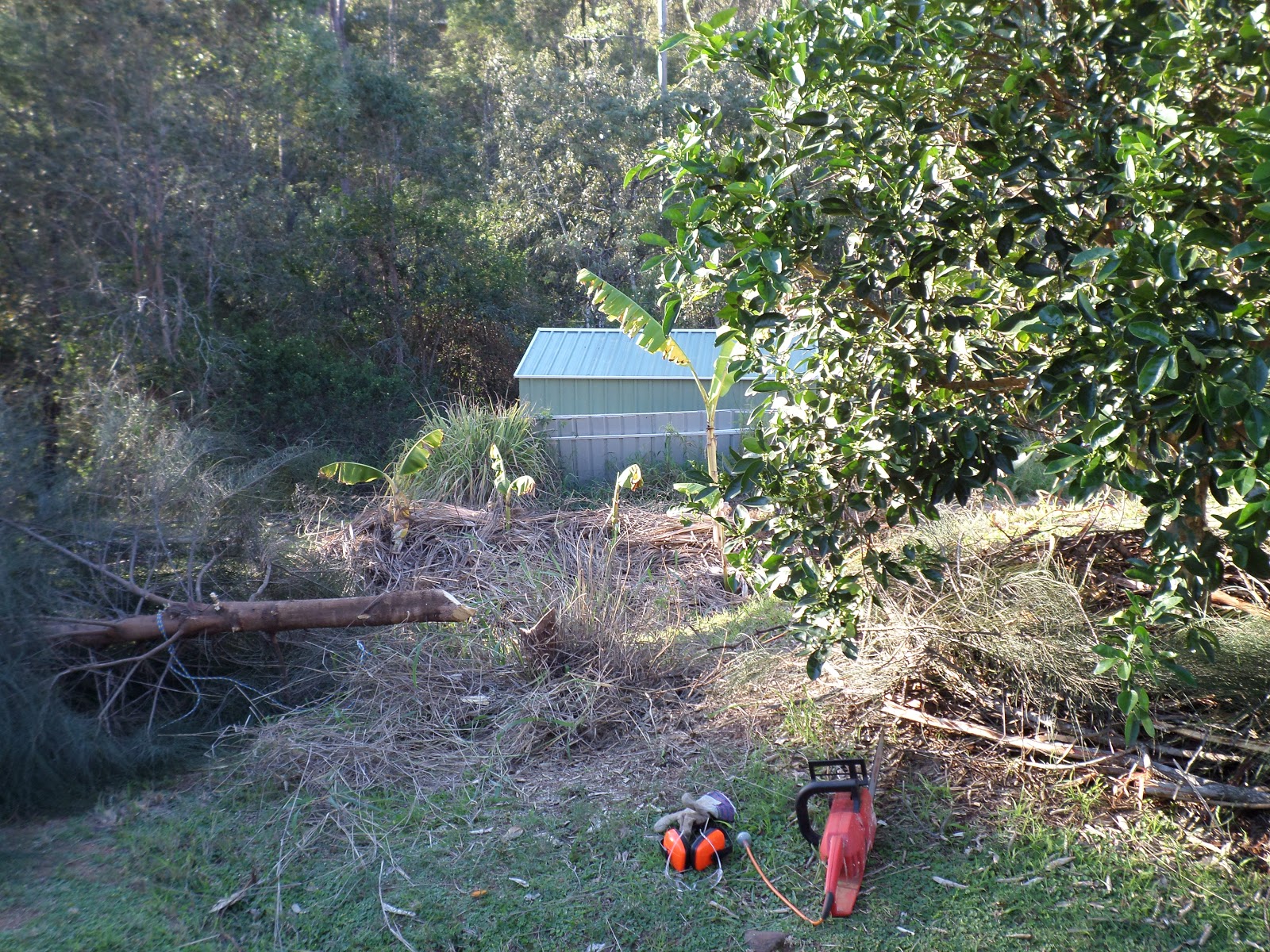
So out came the chainsaw, and the safety equipment. In a matter of minutes, the casuarina tree came down. With spring just around the corner though, we're hoping it will re-shoot, or coppice. That way, we will have more mulching material to place around the tree in another year's time.


Taking out the tree, is only the first step ~
now what to do with it?


That casuarina was about 8 years old, so it had a lot of carbon material to give. And use it, we did! Casuarina can sequester nitrogen from the atmosphere, so it's need-like leaves, are high in nitrogen. It can also reduce pH in alkaline soils, making them more acid for things like blueberries and strawberries.

I actually used most of it's trunk as garden edging/hugelkultur, for a nearby rose bed. It had provided beautiful flowers in the past, but now it was being overtaken by grass. So I'm in the process of using most of the Casuarina trunk, and some eucalyptus trunks we have laying around, for that project. It will then be covered in casuarina leaves. I hope to report on my roses at a later date.


Mulched with casuarina leaves


Of course, I also used a lot of leaves and branches under the orange tree. There was so much material to use up, I had enough to put around both orange trees, and a carob tree too. Not to mention the rose bed.

In the image above and below, you can see the Leng Navel, now has access to full sun.


A balance of sunlight


Those bare branches should fill up nicely with new leaves, and there's enough thick mulch around the tree, the ground shouldn't be exposed to intense summer heat. If the casuarina stump doesn't re-shoot, I have plans to grow pigeon peas and lemon grass, to replace as mulching plants.

Actually, this area will soon be filled with a range of new mulching plants. As we want to continue feeding the trees, which feed us.


Opportunities abound


Just below the recently felled, casuarina tree, is a new banana pit. I look forward to sharing more on that project, as it develops further. We're hoping it will become quite a productive area.

The theme to take away from this post however, is to think more about using all the plants on your property. Whether they be growing wild and you're forever having to deal with them (native trees in our case) or those plants you propagate, with the intention to chop and drop as perpetual mulch, to feed the soil - start thinking how diverse you can make the carbon pathways, across your landscape. How can you increase it, by using it up and increasing it again?

The more carbon materials you can sequester back into the soil, the more resilient your soil will become. Plus, you won't have to rely exclusively on bales bought from the store, to protect your soil. Remember the bank account analogy. By making more deposits than withdrawals, you will soon be richer in abundance.


Saturday, June 18, 2016

A way of coping

I've had the craziest few weeks, lately. My dishwasher broke, my mobile phone died and my credit card has been replaced twice, due to fraud. The second time, I didn't realise my bank had cancelled the card, and ended up in one of those awkward situations, where you can't pay for what you've spent an hour, shopping for - and absolutely need!

So when most of that drama is put behind me, I go find some relief and peace in my garden. Even when it hasn't rained for a while, and looks like its teetering on the edge of death, it's still a reassuring place to visit. Because there are echoes of my hand at work, still there, pushing through the lull. It reminds me things are still happening, when it seems like the rest of my world is upside down.


The lemon grass is re-shooting again. Fresh and deliciously green, against a background of brown. The former stalks were slashed down and left to mulch the footpath. I did this when there were rumours of rain. When the rain did finally arrive, there was much less than predicted. By slashing the lemon grass ahead of time though, I preserved the moisture, which did fall.

Some tasks really show their fruits, only when the timing is right.


Then, there is the pear tree, I resurrected from the weeds. I pruned its branches back too, so it can focus its new growth on less. Today, I added to the mulch I laid down previously, with fresh, pigeon pea leafs and branches. It looked like a patchwork quilt, sewn together, only when the material was ready.

I was feeding the peas themselves to the chickens, and they needed time to fill out their pods. Having stripped the trees bear now however, it was time to cut everything back. Not just for the benefit of mulching the nearby pear tree, but also, for the pigeon pea itself.


Growth is slower in winter. Much slower. But once the branches are cut back, they seem to burst with renewed vigour. New leaves, for new flowers, that will produce pods to feed the chickens again. No doubt, the brush turkeys too.

Cutting back, really does renew things. I take that thought into my mind, as if its a worthy thing to transplant elsewhere in my life. Maybe it will bear fruit another time.


Right now though, I look at the large branches left on the ground, that we collected from fallen trees. I broke them up, piece by piece. Clearing the yard of debris, and placing them under the trees. It's taken many months. I started in autumn, and here I am again, in winter - repeating the same process.

For there is always debris, where new growth is forming. I don't always appreciate this in my other duties in life, but my garden never fails to remind me. It's there every year, and every day. I just have to step into it and forget everything else happening around me.


Then there is our rescued cat, from her feral mother - reminding me, its not where you come from, but where you are, that can be embraced. She always sits on the pallet, watching me - or perhaps to position herself at eye level. So I might run a hand down her back, or just lean forwards, and kiss the top of her nose.

She's not the biggest fan of personal contact, but she does appreciate brief encounters of affection. Don't we all.

I found mine in the garden today, embraced by all those cycles - the lull of waiting, and the drama of cutting back. The repeated cycles. Knowing we're all kind of rescued by nature, aren't we?   


Monday, May 30, 2016

Planning ahead

It's taken a while, but winter has finally started to bight at the heels of autumn. Along with it, came some strong winds to knock down one of our acacia trees, on the front street. It also blew around some stuff in our yard too. Basically it was a messy, blustering few days.


Fallen tree


Yesterday though, the wind had gone and I took stock of what was needing a good tidy. I evaluated the fallen tree, with another tree, near the chicken coop. This particular tree is a Washington Navel orange, and while it has survived many years without much TLC from us (yay for citrus) this year, nearly did it in.

Because the rain has been very evasive, and what has fallen, is less than previous years. It's not the only reason its had a hard time though.


Washington Navel fruit, ripening


We only received one fruit this year, even though several set. I'm surprised even this one managed to hold on, because the poor tree met with some unexpected (or should that be EXPECTED) fowl play.

When we started to let a lone chicken, free range, to avoid pecking in the coop and a bunch of new brush turkey's, decided it was a pretty awesome place to hang out too - well, between them, they destroyed the mulch we set down to keep the moisture in.


The dust bowl


Poultry know where to find all the best meals, and the loose sugar cane mulch, succeeded in ringing the dinner bell. Mulch soon went everywhere. So I put down more mulch, with a few buckets of water to remedy the lost moisture.

Of course you know what happened next, don't you? It quickly fell, to fowl play, once again! When it hadn't rained for a couple of months, and summer temps decided to stick around longer than usual, we had one mighty stressed tree on our hands.


Brittle wood


Branches became brittle and even fell off in the wind. I think it has some kind of insect eating the wood too. I mean, why wouldn't they - a stressed tree, is like ringing the dinner bell for all sundry of pests too? This tree had been in the ground, long before we even built Hilltop chicken coop though - so it was worth attempting a rescue mission.


Missing limbs


The gaps in foliage above, is where whole branches have fallen off. I have to hand it to this tree though, its one tough nut to hold on through the extremities it has. Although, in comparison to its sister tree, also planted at the same time and a mere 12 metres away - a Leng Navel orange - the two seem to be world's apart.


Leng Navel orange


The Leng Navel, has held on to a lot more fruit and isn't as appealing to the fowl's scratching it seems. Perhaps it has something to do with the fact, we planted a Casuarina on the western side, to help block the afternoon sun from this particular tree. Maybe they don't like the strong scent of it's pine-like needles?

But even with the occasional fowl assault, the moisture hasn't been sucked right out the ground due to this companion planting. The Washington Navel however, has no such companions to help it along, which is why it depended on that mulch layer to survive.


Barrow trip #1


When the wind makes a mess of your yard, everything came onto my radar for potential mulch materials, to go under our struggling orange tree. I found an old, root bound pot plant that died. It went into wheelbarrow number one, along with spent potting soil from plants I re-potted recently.

Also, note the bizarre concoction in ice-cream tubs. These are actually spent coffee grounds from David's workplace. But they have been sitting so long with lids on, that they've grown fantastic moulds and fungi! Who knows, maybe they'll kick-start the soil microbes under the tree? This mould, is truly fascinating stuff.


Coffee grounds, mould


It goes orange, and even smells like sweet orange. If you click the image to enlarge, you'll even see some sort of juice on the surface. I don't know how it got there, condensation perhaps, but we noticed the native bees taking a particular liking to one tub, with a slightly ajar lid. You can even see a native bee, still intoxicated by the sweet juice. When I poured the contents under the tree, mixed with the coffee grounds, it actually smelled pleasantly like "jaffa".


Coffee grounds, down


I collected another two buckets by hand, which made a total of four buckets of spent coffee grounds - with who knows what, growing inside them. It all counts as living biota though, which I want to get back into the soil as quickly as possible.


Spent potting mix and plant roots


I broke up the root bound ball of soil, and once the microbes move in, it will act like a sponge to capture moisture. If we get some of those rainfalls predicted in the next few days, it should soak well, and kick start this entire process forward.

Naturally, when I went to collect more materials in my wheelbarrow though, who should I find upon my return? No doubt, checking out the new, sweet, jaffa nectar, I dumped under the tree?


Turkey!


Those brush turkey's are fantastic survivalists. I swear, they watch our movements around the chicken coop, hoping for another opportunistic meal. We don't attempt to feed them, but we put a little feed out for our free range chicken, who seems to be happy to share it with them.

Thankfully, I have enlisted the help of a mercenary in this department of bird control though...


I'm watching you


Our cat, Muesli, loves to scout from this tree, or wait, hidden behind the pallet, to ambush the gaggle brigade. She loves to chase them off, even knowing full well, she won't be having turkey for dinner. Although, they seem to watch her movements too and wait for her to lose interest or go have a nap in the shade.

They're clever, those turkeys! I admire the local wildlife, only long enough, before I start unloading the next barrow of materials, collected.


Barrow trip #2


When the rain doesn't come, and it kills off all the grass, you can either lament the lack of greenery, or you can collect all that dead stuff afterwards, and put it to some use, feeding something else. Autumn has been prompting me to plan ahead for next year. Because what I put down now, will feed the next season's growth.

Which is why these dry times are very necessary. It's how nature prunes material, via moisture deprivation and then the seasonal winds to blow everything down. I just borrow some of nature's ingenuity, and use it elsewhere. So the dried grass went under the tree, but I also had another excess material, I could use...


Surplus compost


When we built our wicking beds recently, we overestimated, how much compost needed to fill them. We haven't been able to use the trailer, due to this over-abundant resource we're still finding ways to use up. So a small amount, would soon benefit our sickly tree.


Barrow trip #3


With another barrow of mulch material, that made three barrows, so far. I didn't use too much compost, because I was just balancing the spent, potting soil, already placed around the tree. I got half way around, with a scant layer, and wanted something similar to cover the other half of the tree

It should all break down over time though, to feed the soil. Given those pesky diggers can be actively discouraged, that is. So I considered the fallen tree up the top, to give me some inspiration. Another spent resource, just waiting to decay back into the landscape.


A pile of mulch material


Somewhat like these trees, we prepared a few years earlier. They fell down from the street too, but we carefully moved them into an empty swale to get them out of the way. It was the most convenient position for them at the time. As they have decayed though (much more, than the newly downed tree) I could break several large branches up, by hand, and stack them under the tree. Making more room in the swale, for the new tree to come down soon.


Sticks down


With a layer of large to small branches and twigs, this should curtail the antics of the scratchers. Although I'll be keeping a close eye on them! Never underestimate the enthusiasm of a hungry, scratching bird. But, I also had another resource to utilise while it was still fresh and vital! It came from that fallen tree up the top.


Barrow trip #4


Like its fallen predecessors, it was an acacia tree (black wattle) which are renown for their ability to procure nitrogen from the air. Unlike its dead relatives however, it still had leaves and flowers to be collected for my mulch rescue mission. This made four wheelbarrows of materials, under my sick orange tree.


Finished!


I'm thinking it will be challenging (though not impossible) for scratchers to remove this particular mulch away from its intended recipient. While it stacked really high initially, it should slowly break down, over time and drop. I was sure to keep the trunk, clear of materials though...


Orange trunk


I didn't want to go to all this trouble, only to give the poor tree, collar rot! So when the rains arrive (fingers crossed) it won't cause further stress to the tree.

I actually got this idea of how to mulch under trees, from what we did to our carob tree several years earlier. We have only ever mulched under it, with fallen tree debris.


Under the carob tree


We've even placed, old pallet wood under it too. We had to do something with it, so why not use it as mulch? It all breaks down, over time, and it means I don't have to purchase mulch materials instead. Our carob tree has done really well, over the years, because all this excess that gets dumped under it.


Carob tree


We also grab another variety of acacia, to mulch it's leaves on top, too. They grow like weeds around here, so we remove them while small and put them under our trees. Because we're putting down leaves, still attached to branches, it's not as easy for scratching fowl to move mulch material away. We've not had problems with this particular tree having its mulch removed.

Although, I'm without any doubt, the local inhabitants will sure give it their best shot!


I can't tell if she's confused by the new mulch ~
or planning her counter attack


The best part is, all this stuff (or a great deal of it) was grown right here. Except for the compost, we really didn't have to venture off site, to collect this massive pile of food and protection (hopefully) for our orange tree. It took several hours to complete, but it was a lovely way to spend the last days of autumn. Knowing, I was making food for my tree, next year - and no doubt for the damn turkey's too, lol.

I must confess though, I was a little saddened lately at the absence of rain, and the fact autumn was clinging on, without allowing the coolness of winter to move in. Because it made my garden look like an absolute death trap for plants! Then when the wind came, it made even more of a mess. But in the stillness afterwards, I had to look around and contemplate, whether these things were actually beneficial to the landscape in the long run - and nature actually intended for them, to take place?

My job: like the turkeys and chickens, is to scratch out a place in the landscape, that will feed me and make use of what's already fallen to the ground. We're always chasing that abundance of course, but it sure doesn't mean the lean times, are any less necessary to our long term survival. It goes a long way, to planning ahead for that next meal. In this particular case, I hope its oranges.