Wednesday, May 28, 2014

Niche gardening

When something fails on a consistent basis, no matter how hard you try - it's time for a complete rethink. This is how I feel about garden beds for growing food. They may work in other places with reliable rainfall or money spent on irrigation, but I've never had much luck with them. Even when I've had a rare year of ideal rainfall, as soon as I'm needed elsewhere, everything bolts to seed or gets infested with overgrowth. For me, garden beds are too much work which I cannot always be available for.

I still keep some garden beds though, because I like the dedicated space for experimentation - but its not something I can keep going for long periods of time. It's not rare for them to become overgrown for over 12 months.

I finally realised recently, nature had been building inexpensive growing systems for millennia - I just had to change how I thought about growing my own food, and more importantly: where!

I have more to share about niche planting in my own garden (in another post) but for now, here is a video sharing the same exploits I've been applying in place of traditional growing areas.


Plays for around 15 minutes


I thought it was filled with some really good ideas, and ultimately utilising a resource which was already there - the forest. I don't think you have to actually own a forest to get something out of the video, but it follows the lines of what I was already thinking about niche gardening. Find a niche with whatever you already have growing naturally, and exploit it. The forest provides canopy and products to sell, but buildings can also provide canopy to be exploited, without having to erect anything new. It's just a matter of observing where on that building, it gets the most sunlight or the least, then decide what might grow best in those locations.

I wonder if pumpkin vines would do well, planted just underneath a raised house? So long as they weren't planted near stairs or any other access point to the house, the pumpkin vines could virtually be ignored until it was time for harvest. The coolness under the house would stop evaporation during summer. I wonder how well watermelon would do in those growing conditions too, as they seem to be particularly fussy about moisture? If I had a raised house, I'd be experimenting with what I could grow underneath it.

Our house is built on a concrete slab instead, so I grow stuff around it - utilising the micro climate of the concrete. Really, the possibilities are limitless though. I like the thought of utilising what's already there, and seeing what a humble little plant can do to transform that space.

If you have any magic growing areas outside the traditional garden bed, please do share.


Tuesday, May 27, 2014

A volunteer experiment

Home made compost is great, not only because it feeds the soil while taking care of organic waste, but it also creates volunteers. We obviously don't make our compost hot enough to kill seeds, and we'll even use it before everything has broken down completely - ergo, there are many opportunities for volunteer plants to take shoot.


Barrow


We've had pumpkins and tomatoes by the barrow full. Even the odd potato, which ironically did decide to volunteer in a "barrow" this year. Thus my experiment began for growing potatoes. By chance, another potato came up in a bed I topped with our compost, and it has since joined the barrow potato.


Potato volunteer


I've not had much luck growing things in wheelbarrows, but I'm not one for giving up after the first failure (or two) as I keep learning the more I experiment. Like some pumpkin seedlings which sprouted in another barrow. Rather than throw them all out, I tried transplanting some instead.


Kent pumpkin volunteers


I took a group of three which came up together, and planted them behind a shrub. One has taken off, another is waning (the yellow leaf above) and the second may survive. My strategy to plant them behind a shrub, is finding a "niche" I've seen them develop in the wild as their tendrils search for places to root. They always take root in shady, moist places, which allows their tendrils and leafs to expand out into the sun for photosynthesis.


Nature's trellis


As you can see, the shrub has shade behind it, which is normal for this time of year. By using a semi mature shrub, I don't have to worry about the pumpkin vine shading it out or strangling it. I have other plants in the garden which are still young, which I have to constantly prune the pumpkin vines away from. I also won't remove the grass or weeds. It all counts towards cover and reducing evaporation. The cool of autumn doesn't evaporate so much, but it can still kill tender seedlings.

I had another single pumpkin I tried transplanting in a more exposed site, but it died within 48 hours. So it helps if you can plant groups of seedlings which volunteer together, as well as finding a semi-shaded site to move them to.

We've been experimenting a lot in the garden, based on what we observe volunteers doing. Next time you see something sprout from the compost, ask yourself - where can I put this in the garden which would mimic optimum growing conditions? It might be that shady side of the house where nothing ever grows. Try planting a pumpkin vine which can travel into the sunlight, and it won't get in the way. Most out-of-the-way places we avoid because of the terrain or reduced sunlight, isn't a problem for plants which can travel by tendril.

Even though I cannot really eat potatoes (avoiding the nightshades) the rest of my family still does. I also want to see if I can tolerate home grown ones. I found that out with dairy. Whenever I eat it, I develop a cough. The exception is when I eat raw milk. I'm hoping its the same with the humble spud!


Saturday, May 24, 2014

A Mother's Day surprise

I didn't have a cake on Mother's day, because who needs the calories right? Neither did I get any presents just for being a mum - I actually think being a mum is the present and I get to experience that a lot. But there was something 'afoot' on that particular day, and mainly on top of our roof.  I mentioned recently, David and I had some large financial decisions to make over Easter. On Mother's Day, we saw the realisation of those decisions...


Click to enlarge


It's a 5 kilowatt system, consisting of 20 solar panels. We just had enough room on our roof, with our existing solar hot water system (centre). The installers even had to move the tv antenna, so they could fit them all on the northern side.

Why such a big unit? We run a septic system 24/7 and a water pump for the house too. Plus we don't have a wood burner at the moment, so the house is heated via electricity during winter. Our bills during that time can be in excess of $800 per quarter.


Our anaerobic septic system


Of all the things we weighed to use our money for, solar was the only one which would reduce our expenditures consistently. We originally saved the money to buy a wood heater, but it would only reduce our expenditures during winter. We still intend to get a wood heater once we save the money again, but its a big outlay for such a small window of return.

The fact I'm talking about money when speaking about solar is I don't believe we deserve any credit for being environmentally minded. A grid connected solar system, depends entirely on the electricity network to operate. It does provide free energy from the sun, but this particular system relies entirely on fossil fuels to operate. In terms of sustainability, you really need a "stand-alone" solar system, which means the solar panels are connected to a battery bank, instead of the electricity grid.


Pineapple and sweet potato


Our main environmental challenge is the green we can produce in the landscape. It takes a lot longer to make a return in the garden, than one afternoon with tradespeople on the roof. People who mind their gardens or find ways to eat locally, contribute a greater effort to being environmentally friendly because its a daily commitment and generally uses more elbow grease than fossil fuels.

I've written about solar before, and I wouldn't say my views have changed a great deal. We only purchased panels recently, because the Queensland government decided to remove the generous subsidy they were giving households, putting solar energy back into the grid. That's why I made the appointment to speak to a solar company recently - I wanted to hear what solar would look like without the government subsidy.

Once I saw households would be paid "market value" for the excess energy they produced by their electricity supplier, I felt it was a more realistic system of exchange. I've written about what government subsidies can do to a household budget and the price of goods here and here. I intend to write a third and final post, in my series about Individualism. It was always going to be about solar, because that has been the latest government incentive to get households to change the way they do business.

Our hands aren't completely clean however, as we did receive some subsidy for installing the system, but I will discuss the details of that in my final post about Individualism.

In the meantime, the sun has decided to go into hiding. While I know our panels aren't producing as much power because of it, the garden really needs these gentle days of reprieve from the sun. It triggers so much growth and change that I cannot begrudge it's necessity.


Monday, May 19, 2014

Looking dapper


A special little somebody, turned one recently. How the time has flown by and how he's transformed into a little boy, right before our eyes. What a cheeky little smile he has too, but if you're wondering where he gets that snazzy dress-sense from, just ask his dad...


David wanted to get Peter a tie and and outfit for his first birthday. My two special guys with ties! What a carefree and uneventful time we had for his first birthday, unlike the day of his arrival. I look at how happy he is today, taking his baby footsteps which make him giggle all the way to my legs - it's hard to remember that tiny baby in the humidicrib, with tubes in his arms which made me worry I couldn't hold him in mine.

What a difference twelve months can make. We'll be happy if the next twelve months are equally as uneventful. Smiling over regular stuff in life, holding hands and stealing as many cuddles as we can in a day. It may be uneventful, but what a way to live!

We're glad you came along, Peter, even if you do get into absolutely everything now with your eager curiosity and newly found motor skills. It's all just part of growing up. I bet the next year will fly by, just as quickly too! May you keep reminding us that smiles are infectious and you're never too young to wear a tie.


PS: This is a velcro tie, so comes off when pulled - in case anyone was worried it could be a choking hazard.


Sunday, May 11, 2014

It has begun...

Late autumn 2014
7 years old


It's a little earlier than expected, but its time for our canopy tree to be cut down. David has started trimming the branches first, as they were overhanging the roof and a small tree underneath. By cutting the branches on one side, it will also make the tree lean to the heavier side when it's felled.


Tree bling


But there is still time for one last snake skin, to glisten in the afternoon sunshine. How many skins has this tree helped remove from growing tree snakes and pythons? Many I suppose...


Late afternoon


And there's still time for one last view through the leaves and the blue sky. A real treat for Peter and I in the afternoons, when we sit underneath our canopy tree and talk about its journey. It was the first tree to shade him, when he first came home from the hospital. It was Sarah's favourite tree to play under for so many years of her early childhood. And I told him recently, the tree was going to fall soon, with its branches and trunk to kiss the ground, one last time to feed it.


The stalker


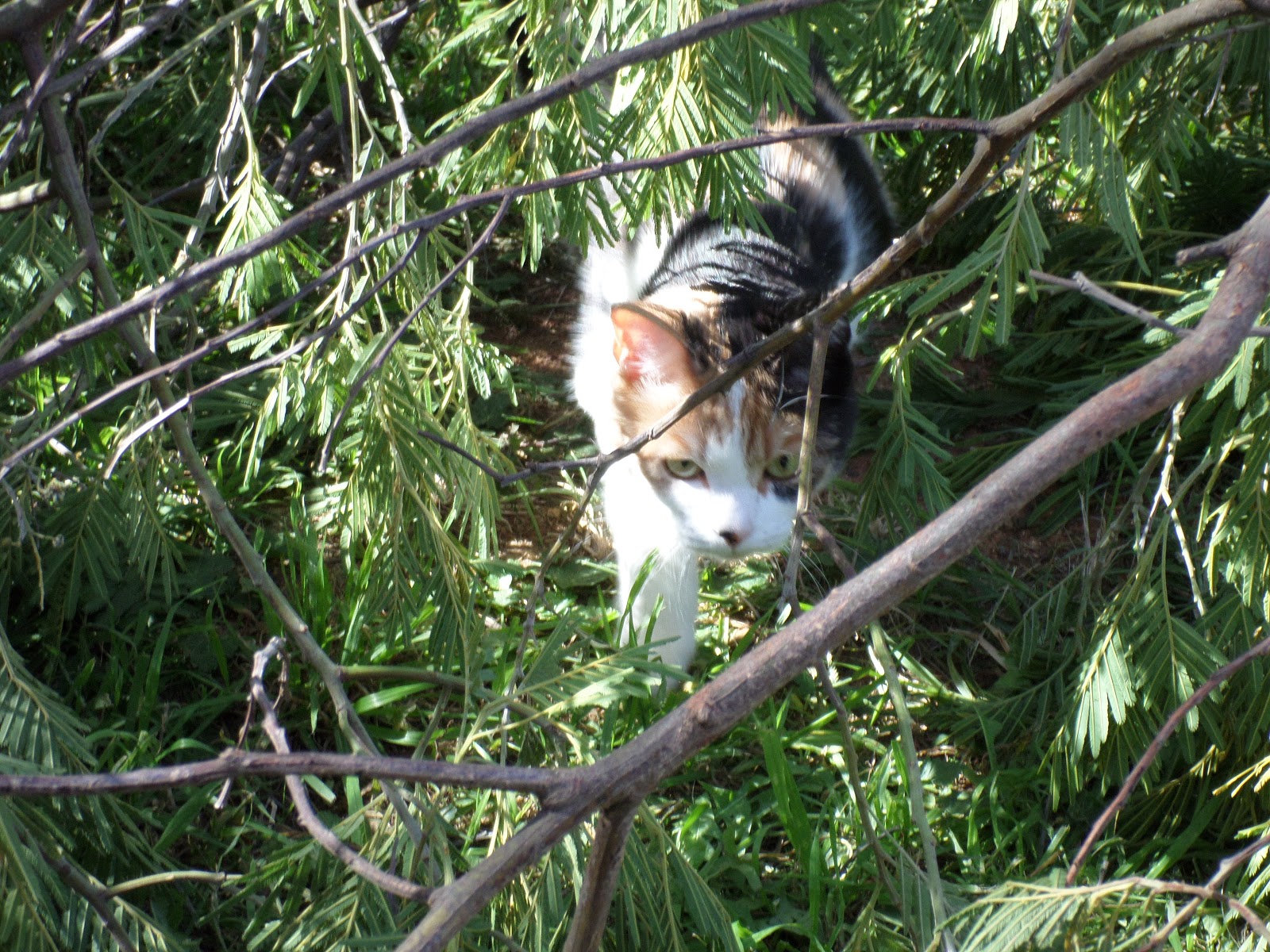
There is so much life given by just one tree. It's a miraculous gift. Our cat now well on the mend, had time for one last adventure, underneath its branches in an entirely new way too. I know she will miss this tree as well. But the good news is, we have another tree growing underneath, which needs the sunlight to help it grow - starting life, somewhat like this...


2009


And after five more years, it's grown quite a few more branches. Our hot-pink frangipani will love the new light conditions, even though it's almost due to start shedding leaves for the winter.


Shaded by canopy tree


Maybe it will become our new canopy tree. A longer living one, and not quite so tall as to shed its leaves in our gutter. Being deciduous, it will let in the sunlight during winter too. But I think it needs a companion, to replace the one we are taking. I like to think with every tree we take, another two can be planted. That's how important trees are to us. They bring the animals right to our doorstep and offer a calm place to sit in the garden.

There was a reason the tree had to go slightly early - we were planning to take it down mid winter anyway. But more on those reasons soon.


Monday, May 5, 2014

May madness

May is the month of birthday's for our two kids, and also happens to be the month for celebrating Mother's Day too. This year in particular, we wanted to make-up for the party Sarah didn't really get last year, on account of her brother being expected to arrive any week then.

So we decided to do something really adventurous this year, completely out of the ordinary and hopefully a lot of fun! David got his thinking cap on, his brush cutter out and got to work in the back yard. Soon, little barriers started to emerge involving pallets, stakes and piles of deadwood...


Strange?


We didn't have to buy anything new for these temporary structures, as we had a lot of stuff laying around. It's amazing what you can hide on five acres. Especially on slopes, where you can always have a good lookout in case you need it...


That's new


There were plenty of footbridges to cross too, for the necessary escapes - as you never know what's lurking in the Australian bush...


Beware


And many a fort was built to defend, in case of marauding zombies from the apocalypse - or kids just high on adventure....


Don't let the birdhouse fool you


The day came and went. Madness I tell you...every step of the way! But it was worth it. For the first time, we actually got to use the back yard as a play area, even just for a day. A day where we could pretend to be adventurers, out to get one another with lazer-tag guns...


Click to enlarge


We even had green face-paint for camouflage. Sarah is in the middle, wearing a red headband, and black shirt. Little Peter was the team mascot, but spent most of his time inside, sometimes playing with a little present he got from one of his aunts and family...


Soon to turn one


His birthday is not that far away, and David is vowing to have another round of laser tag, in about nine years time - when Peter may enjoy the experience. Although one of his uncles has joked he may be too old by then, to crawl around on his belly. He literally disappeared into the bush, and couldn't be found, although I'm sure he tagged quite a few unsuspecting participants.


Casualties in the battlefield


The funny part was at the end of the day however, when he decided to charge the faux-wall David built with styro-foam boxes. David didn't tell his brother, they were half-filled with water, so they wouldn't blow away in the wind. In his mad charge to capture the enemies flag, he got a wicked drenching!

Even I had a go with a lazer gun, and didn't realise how engaging the game would be. Just when I thought I found the perfect position to tag someone - I discovered I was being tagged multiple times by an invisible assassin. It's maddening, trying to locate where they're hiding, as you duck for cover. Even more so, when you cannot locate them, but their perfect shots just deactivated your weapon.

The kids went outside many times to play, as it was too engaging to let lie. But I must say, when it was time, we had everyone mesmerized inside with David's birthday cake creation....


Hi Dad!


It's normally my privilege to make the birthday cake, but what good is being a chef, if you don't once make your daughter a profiterole tower! He doesn't look too confident, lighting a candle on top of all that chocolate gnash though. Like his iron will, it withstood the test.


Embarrassment is hearing everyone sing happy birthday


Sarah loved her birthday cake and so did everyone else! By the time we were halfway down eating the tower, kids started arguing who was going to eat the metal cone in the middle, because it was covered in chocolate gnash!

I can't believe her special day has come and gone. So much preparation and work went into just this one day, and right down to the wire in some cases. The profiterole tower was finished not long before guests were due to arrive, and I had a sink load of dishes to get done too. The dishwasher was already full and cycling. But I guess, that was part of the adventure too.

We don't normally do extravagant parties, but I guess with her brothers arrival last year, we realised the day our daughter entered the world, we changed completely as a couple. Her presence broke us from being self interested adult-children, and made us more giving. And seeing how generous she tries to be with her little brother now, well it brought the children out in us again. Only this time to celebrate new milestones with a sense of adventure and unity.

Happy birthday sweet Sarah, thanks for taking us along for the ride.

Wednesday, April 30, 2014

A tale of two trees

This is a tale of two trees, or rather, two ways of managing trees in the landscape. We've had our citrus in the ground for around six years now, and they've had to fend for themselves after the first summer. I want to focus specifically on our Lemon and Lime trees, as they've had to cope with the harshest conditions.

They live mostly off natural rainfall, and the lime tree in particular, has had to cope with full sun in every summer growing season.


Lime Tree, planted July 2008


Both trees are planted near block retaining walls, so they drain really well (great for drainage) but they also dry out really quickly too - which is bad for fibrous roots. The lime tree above, recently got a hard prune for the first time in its young life. I wanted my trees to grow in the Jackie French way, where I didn't prune the tree - allowing nature to dictate how it preserved itself. Mainly because I wanted these trees to look after themselves too. I didn't want to mollycoddle them every year, in case I couldn't be there to rescue them every year.


Mysterious lichen


The Jackie French way, certainly made the trees survive the furness which is our summer growing season. Had I chopped back limbs, I'm sure the summer sun would have dried the earth underneath and killed these trees quicker - especially last summer. But the branches grew intertwined and gave the tree a thick canopy above. Enough that it could even grow Lichen on selected branches underneath.

I would not have been able to photograph the Lichen if I hadn't given the tree a sever prune recently. The branch (above) is facing the western sun. Which goes to show, the canopy of the tree grew specifically to protect the trunk from the hottest sun - the afternoon sun from the west. I was fascinated to find the Lichen growing on that side, because it demonstrates the supreme intelligence and adaptability of nature. Hottest sun of the day (no worries) intertwine the branches to prevent exposure.


Lower branches removed


As I was pruning the tree limbs, I noticed something else about nature's intelligence. It grew branches perfectly, to balance the weight in each limb. It took a while, carefully observing, where I should prune each branch to open up the canopy. I had to select branches that wouldn't unbalance the limbs by removing them. After six years growing the right way to protect itself, I didn't want to set it up for failure next summer. So each branch I removed, had to balance out somewhere else.

Which brings me to explaining, why, if I had such success with the Jackie French way of managing trees, I would revert to the Peter Cundall enthusiasm for pruning trees instead? First point is simply the ease of management, but more importantly, only because disease management became an issue. I need to show the fruit to explain further.


Healthy lime fruit


Here is the lime tree fruit, which despite the summer heat, bore heavily. For the most part, they were healthy fruit, but a few started to exhibit signs similar to the lemon tree, that was now in dire straits.


Lemon fruit with citrus scab


I've not had a decent crop of lemons since 2011 and mostly because of the increased shade, due to trees growing-up around it. Also, having too many branches crossing on the lemon tree, has not helped either. It set the conditions to become a pest haven for everything to attack, when it was (once upon a time) our best producer.


Lemon branches


This image is of the lemon tree, but also what I had to deal with, when pruning the lime tree. Intertwining branches aren't so bad at the top of the tree, but when its all over, its difficult to see what's happening until the fruit start exhibiting problems. I would have continued with the Jackie French way of growing trees, had my six year old citrus, not shown a decline in health.


Eureka lemon tree


I should mention, the two trees pretty much managed themselves for five years, so the Jackie French method works. But when intertwining branches become a problem to the overall health of the tree, they should be removed. That should be judged by each tree, every season. Some trees may not need interference at all. My two oranges and one mandarin, have not been pruned, and produce healthy fruit.


Lime tree, right


I'm attempting to improve the moisture prospects for the lime tree also, by using a swale like berm, made from tufts of grass I've removed from elsewhere. The lower image gives a better view of how the berm/swale will collect moisture in rainy periods, because its taken from the top. The lime tree looks very bare at the moment, but I've pruned in Autumn, so foliage will get a chance to grow back before the next summer heatwave.


Lime tree, left


I like to use the big tufts of grass in the garden now, because I see it as a valuable resource. In the past, I would have purchased bales of straw to mulch around my trees instead. But I don't see the point in using energy to acquire materials, which I already having growing around me. It's not a neat, immediate bundle I can purchase conveniently from the store, but it's just as good at doing the same job, once I collect the materials in my garden and mound them together.

I'm happy to have started with the Jackie French approach (my trees are alive because of it) but intervention is sometimes required once problems arise. I don't believe the method is flawed just because I ran into problems six years down the track. Nature is doing exactly what it should be doing - weeding out the trees that aren't vigorous enough to compete with other elements. Having invested so much time waiting for edible trees to produce however, it would be counterproductive, not to find different ways to give them a slight advantage.

Minimal maintenance, has now become a little more involved, but the focus is still for the trees to ultimately look after themselves.

I will continue to allow as many trees as possible, to go without much intervention from me, beyond the first year. But I also know, I don't have to let a mature tree die just because it runs into some trouble either. I prefer the wilderness garden approach, but I can handle some extra work when its justified.