Sunday, August 3, 2014

Culinary traditions

What could I do on my 40th birthday, to challenge my comfort zone and yet still preserve some of that tradition, which is in keeping with my character? Make Choko Chutney of course! I know- I should be inviting everyone around for a huge party, to receive the obligatory jokes about growing old, being over the hill and how my physique will go down the hill with me. But (believe it or not) that's not how I like to celebrate...*wink*


I had some chokos that were starting to sprout and it seemed such a waste not to use any. Plus Choko Chutney reminded me of my teenage years, when mum would make a special batch after harvesting the vine. I would eat Chutney on toast, meat sandwiches and even in the curries mum would make for dinner. If I was going to relive any part of my youth at 40, I wanted it to be through the divine experience and satisfaction of food.


So it was I followed an old recipe, threw in a few flavouring modifications of my own, and ended up with 4.5 litres (4.7 quarts) of Chutney - nicely canned and labeled in the pantry. It was a little frustrating to make, as I didn't have proper canning equipment, but it was also deeply satisfying after it was done. Especially when it came to the tasting! On my gluten free toast now, it still reminds me of my teenage years - memories of hot toast in the cold mornings, before walking to school.

With years of experience behind me as a baker though, I decided to use the Chutney in making a peasant loaf. So new memories to make for a new era. This loaf was not a gluten free recipe, I was a little naughty by tasting it - but it was a real hit at morning tea, I hear, at one of David's Doctor Who Club meetings.

It uses a standard bread recipe (I used sourdough) for one large loaf, but the dough is cut in half, to make two peasant loaves. I'll let the pictures do the explaining though...


Roll halved dough into a 30cm long rectangle, smear chutney & sprinkle cheese


Roll into a sausage lengthwise, then place on greased tray ~ seam down


Use sharp scissors to cut into dough on an angle ~ avoid cutting bottom seam


Push slices to alternative sides then prove 30-60 minutes depending on temperature
~ Do the same for second loaf ~


Sprinkle with cheese before baking in preheated oven
I would have liked mine to prove longer, but was on a deadline


bake for 25-30 minutes at 180 degrees C


Freshly baked and placed in a basket, on top of a clean towel 
and 2 layers of butchers paper ~ wrap paper over to keep warm


This basket was a birthday present from my family, I made the gingham cloth
It made transporting the freshly baked peasant loaves to the meeting, easy


If you're interested in the Chutney recipe, you can find the one I used here: and my modifications are:

1/3 cup salt (reduced from 1 cup)
1 tab mustard seed
2 tabs mixed spice (or all spice)
6 tabs cornflour

I also opted to use the sultanas, as it does add some more sweetness. I cut the salt back to a half-cup, and covered the veg with water instead, to soak overnight. You will need at least a 6 litre pot for cooking. I didn't have one, so used my slow cooker instead. Took me a little longer to boil, but it was all I could find to fit it all.

If you want chunky style, chop your chokos small, as they won't disintegrate after cooking. Choko is special like that, as it will continue to hold its form. The recipe linked to, suggests using a potato masher if you want a smoother chutney, but I used my metal stick blender instead. Made short work of the chokos. I would recommend a smooth chutney, as its easier to spread on bread. I also found the chunks didn't really carry the flavours as well.

If you think it tastes too vinegary, then wait a week before eating. I've already opened my second jar though. I love it a lot. So does David. Unfortunately, I haven't managed to get my daughter to try it. Alas. Peter also squished up his nose too, so I only give him the slightest smear when he shares my morning toast. He loved it in the curry I made the other night though!

The Choko Chutney experience, was really about me getting to relive part of my youth. That time in my life when I didn't know I was going to become a mum of two and find my sweetheart. Back then, it was about finishing school and not freezing my kneecaps off, on the way to it. The Choko vine my mum used to harvest every year, would shade my quail run, where I was successfully raising several batches of young - or the parents were. Now my personal Choko vine shades the chicken coop.

Some things just don't change, no matter how old you get...


Friday, August 1, 2014

Remember the trees

I've had this post kicking around my head for several months now. It's a combination of all the years of observing the changes to our landscape, and the shared environment with our neighbours. What we all do on our land, and the choices we make in our stewardship, effects everything in our environment. Not a lot of people however, always pay attention to the specific details.

Before I go any further though, I want to share some amazing things I've witnessed with trees. These aren't the living ones, but the ones we've left to add to the habitat once felled.


The story begins...


This Spotted Gum was big, at least 30 metres tall and too close to the house. We spent $400 getting a professional tree lopper to take it down for us and cut it into lengths. That was roughly five to six years ago. It's girth was over a metre wide at the base...


Interacting


We used its remaining stump as a birdhouse stand, and built a play fort around it. Our daughter used to be just tall enough to slap the top of the stump when it was first cut down, and now it would reach her waist. While my children have grown up around a decaying tree, would you believe this tree still has some life in it?


Symbioses


Or perhaps I should say, the tree has some life still growing on it. When the wet season arrives, the decaying matter on the ground grows all manner of microscopic lifeforms. What we can see without needing a microscope however, is fungi. This fungi can be food for various other creatures, and fungi is what moves nutrients around the under-story, making it available for other plants to take up and grow. So you see, there is still a lot happening around this old bitty.


Marked from the past and present


On the wood, are remnants of the beetle larvae that would live part of their life cycle underneath the bark. This was food for the cockatoos and marsupials while it was living, but it now grows fungi instead, and provides homes for wasps who like to burrow into the wood to carry out their life cycles too. Had we decided to burn this tree, like our neighbours tend to do, we wouldn't have witnessed this amazing second life that plays out around its fallen form.


Dark, organic, soil under the log


There is always evidence of digging around decaying trees. It's either echidnas looking for termites and ants, or other marsupials which like to eat juicy bugs that burrow underneath the logs. When we stop to pay attention to these very ordinary details, we get to witness how nature uses organic matter, and gives it back to other living organisms to prolificate and reproduce.

If I had to replace the organic matter this old tree has produced, by hand, I'd be looking at around a few tonnes. Fifty trips with the trailer perhaps? It would cost more than $400 to replace what this tree has provided in the environment it grew up in and then fell upon. It's still got a lot more organic matter to give as well - its continually producing it.


Synchronised compost piles


We still have chunks of log around the yard, doing their part to help nature along. This is an area which is begging for organic matter, and other people just collect it and burn it because its considered neater. I'm all for having clear tracks and areas which will be used for human activity to take place. But just to have a barren landscape after removing the trees and burning them, its any wonder this region is slowly evolving into a desert.

One of our neighbours hired some earth moving equipment recently, to almost completely denude their property. With their new lunar landscape, they spent many weekends filling our neighbourhood with smoke. Then after all this effort, and what I imagine would have cost a few thousand dollars, they started parking their vehicles next to our shared fence line. For ironically, there were trees growing on our side, which could shade them.


Reaching out


I was more than a little upset with that, not because they got to enjoy the shade, but because they didn't think anything living on their side of the fence, would appreciate the shade either. This summer, the outside temperatures are going to be hotter, thanks to our neighbour's new lunar landscape, and we're already feeling the effects of the wind. What used to be the most protected side of the house, is now blowing dust. Their line of tall trees are gone, so the wind is free to blow through the gullies unhindered, until it hits our house.

Most disturbing of all, is having to witness the kangaroos getting skinnier. I planted extra pigeon pea trees to help them through this normally scarce food period. But what extra I planted was quickly eaten in the first month of winter.


Joey's off mother's milk, searching for vegetation


The knock-on effect of what the neighbour did, by removing all those trees and burning them instead of letting them decay on the surface, is deprive a generation of creatures their food supply and homes. There will be less creatures around for next season, to start the life cycle of nature again. This is how deserts are slowly created. We strategically remove anything of value at a few thousand dollars, and then let the natural systems degrade until we completely expose ourselves too.

It scares me to think I can feel the effects of what one neighbour did on a few acres, compared to what must be happening all over the world on larger chunks of land. Forgetting our responsible stewardship of the land, guarantees a poorer system. I'm not suggesting trees can never be removed, or that fires can never be lit, but if that's all individuals do for land management, while working hard off-site, to pay for the air-conditioning - then it seems like a counterproductive means to an end.


Let them live again


Truly, we won't get any climatic comfort by completely disregarding the environment we already have. There is much talk about carbon and government policies being responsible, but those things we cannot directly control. Reducing our carbon footprint or voting for greener policies, won't necessarily translate into lower National emissions, or a government who will curtail industry from polluting. But regarding trees, shrubs, ground covers and other living creatures in our environment, anyone can effect that today.

Anyone can look at something growing on their land and ask themselves, what is living on it or what is completing its life cycle through it? What if I had to remove that living thing for necessary reasons, and what would I replace it with to return the balance? Can I plant more of it or find something else to compliment it?

When I walk through our property, I see cycles upon cycles, and I'm extremely privileged to bear witness to it. My children's silhouettes are imprinted on this land, along with the baby Joey's. Is there no finer mark of a steward, than to remember these things are never to be set apart? What we do, will always effect something else. So it bears remembering those tall giants - with one life growing and another spent decaying, is for the next generation to begin.

Has your land (no matter how small) spoken to you lately?


Sunday, July 27, 2014

In a week...

Last Sunday, I got this brilliant idea to change an area which needed a face-lift. No problems, I thought, just a few rocks and we'd have it finished in a day. Ha! We tried to remove some stakes by hand (holding some of the logs in place) but ended up having to cut them off at ground level. Most of the day was gone by then...alas.


All new nursery plants


This was the area nearly three years ago. It looks as fresh as a daisy back in 2011, but most of the plants in this area died. After the grasses at the base eventually went, I required a new retaining wall solution. But I was to learn how dry it would become in our winters, when we normally have little rainfall. This year, particularly so.


Yucca (left), eremophila (right)


This is what it looked like seven days ago.  Dry and overgrown. The yucca and eremophila (native fushia) are what you can see in the image. They are plants which have adapted to desert conditions, and the only reason they have survived. Another prostrate eremophila, nearly didn't make it though.


Eremophila ground cover


Since I have mulched and made an effort to water it recently, new growth has formed on its bare branches. I was happy to save this particular plant, as its rather beautiful with its silver-grey foliage.


Prostrate eremophila foliage


Eremophila has to be one of my favourite plants to grow here, and it typically does very well on natural rainfall alone. The honey-eaters and bees especially love the flowers. Another hardy plant I had to rescue (only planted last year) was a lomandra grass.


Native grass


This is "Tanika" lomandra, and survived our incredibly hot summer last year. But it was starting to die back with the extended winter drought. With some new mulch, water and removing a lot of the dead stalks, I think its in better shape for next summer.


 Old mulch (left) new mulch (right)


This is our jelly-bean plant (next to the yucca) and ideally it wouldn't be this red. It's supposed to be light green, but living in such an inhospitable area, it dons the red protective colour to retain moisture. With the new revamp, I'm hoping to help it out a little more.


David took this photo without me knowing


I decided to build another rock retaining wall, and it meant a lot of standing back and evaluating the level, by eye. Not very scientific or mechanical I know, but I'm an organic worker. Actually, I'm lucky to be any kind of worker, with my little fella in-toe. I couldn't have him on site, in case he tipped a barrow full of dirt on himself, so I was limited to working on the wall when David was available to baby-wrangle.

That's why it took me a whole week to do such a small wall, mostly by myself. David helped collect some rocks around the yard and did some weeding in the beginning, but it was a small area to work in so was best to have a single worker.


Yucca (background), eremophila, lomandra and prostrate eremophila


I have mostly finished the wall now and the new area has come alive again. I'm happy to have some mature plants (survive) to give an instant effect of foliage, in what is an incredibly dry area. I have added some new friends to the wall garden however...


Lavender Avonview, now in revamped area


Would you believe, the spark of this whole idea last Sunday, was a humble little lavender plant? A lavender out the back, threw 3 little seedlings which I was able to transplant into pots. I thought a lavender plant with its colourful purple flowers would look nice in this area, and decided to start moving rocks.


Mostly finished


It's not the only reason I was inspired to revamp this area however. When I decided to re-work the swale above, it naturally drew my attention to the overgrown and dying area below. I always notice areas that don't work as originally intended, but when you're living on acreage and raising a family at the same time, it takes a while to get around to fixing things.

It was certainly a long week of work, but I'm content with the results. At the halfway mark however, I was tempted to believe it was a bunch of sweat for nothing when David said, the wall reminded him how I like to bring my ideas into being. From one little lavender plant which happily sprung up by itself, to a weeks work of rock moving and baby wrangling.

At the time it feels like the work will never end - the muscles ache, the baby cries for mum to come inside and the project is left incomplete (again). I kept hoping for rain that never came either. It's easy to think in those moments, what difference does building a wall make anyway?


Some inspiration


Building a wall doesn't make much of a difference to the rest of my responsibilities in life, or the weather for that matter, but it's an act of adaptation nonetheless. Embracing the environment I have, using the natural resources available is attempting a balance between extremes. That is my responsibility and (surprisingly) pleasure; finding something in the environment I can marry to my concerted efforts. I look at the wall now and see adaptation at work, something which will probably never be finished.

So in a week, I didn't manage to change the world for the better, but I'm content with the labours I chose for myself anyway. Is there anything you have struggled with over the past week?


Thursday, July 10, 2014

Landscape rework

I warn you, this post isn't going to be pretty, and for good reason too. We're trying to improve a piece of land above the house, which also incorporates our large swale. It works okay as a swale/pond in wet weather, but we never were happy with how we left it. We didn't get a lot of plants in, and what we did get in, was kind of haphazard.

So in between our long dry periods, only the hardiest of weeds survived. It's overgrown and I don't really mind that, but its the fact we haven't improved the soil structure which is the most disappointing.


A level strip of land on a slope


This is the Swale presently. We haven't had a good drop of rain for several months, only the occasional drizzle. This is on a north facing slope, so without adequate tree cover, is subject to continual evaporation when the sun is out. The soil is a combination of red clay and sandstone, which we learned while digging the swale by hand.

To give an indication of what it looks like in wet weather, I have to refer back to late 2010, a few weeks before the 2011 Queensland floods.


Full swale


As you can see, the area is quite effective at retaining water when it *does* rain, but our incomplete design didn't cater for better resilience in the opposite conditions of dry. To give an indication how important shade is, there's another part of the swale, directly behind me, where I was taking the pictures above.


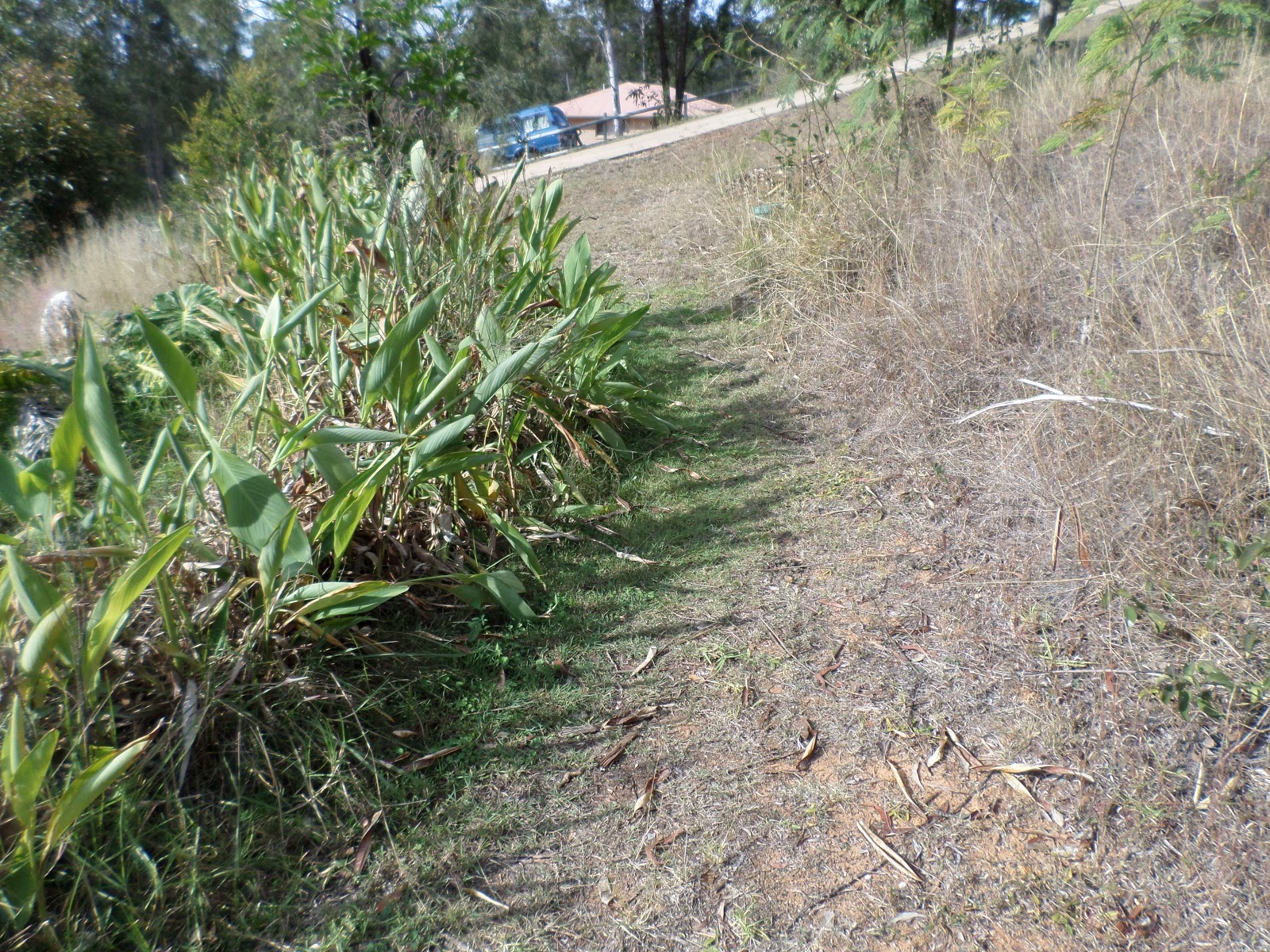
This picture was taken on the same day as the first image, but the difference here is, where the canna lilies cast shade onto the grass, it retains moisture longer than the grass exposed to full sunlight: hence the visible green strip of grass. This image is taken in winter, so the canna lilies are capable of casting a long enough shadow to effect the growing conditions of the grass underneath. This is despite the lack of rainfall.

So this living example proves the importance of shade in this particular area. If we want to retain moisture to change the soil structure, we need trees.


Clapps Favourite pear, with falling leafs


We did end up planting trees at the same time we dug the swale, but several have since been removed or died. The grapefruit died, the kumquat was transplanted to a completely different area to save its life. The pineapple quava was removed and put in a pot on the verandah this year. The only two remaining trees were two pear trees (one shown above). Just to show how inexperienced we were in the beginning, we chose two pears of the same variety, with no pollinator. No surprises why we've seen no buds, apart from the abysmal conditions we've raised them in.


Pigeon pea stumps, pear at rear (4 years old)


Pigeon peas did really well here though, self-seeding and then successfully protecting the pear trees. The pigeon peas also became a food source for the kangaroo mamas and their various offspring. Which is why it was very difficult to cut down the trees from this area recently. It had to be done though. I left some stumps in hope they would re-shoot and give them some nourishment. I did plant extra pigeon peas lower down the slope, in anticipation I would remove this lot from the swale.

I laid down all the pigeon pea branches on the walkway, and then David and I carted bark mulch over the top. In the wet season this will break down, then we will have to add more mulch. We anticipate having to do this for several seasons.


Mulching walkway


What's all this in aid of though, but to bring in a better design to connect the areas which are slowly degrading. You'll have to forgive my rough paint skills in utilising GIMP, but this is the design we are hoping to aim for.


A green corridor - click to enlarge


This image is taken at the opposite end, to the very first image. We've got room for a pollinator pear on the berm (closest to the swale) and we'll be planting a row of hardy natives along the walkway, which we've already begun. In winter the natives should cast a shadow towards the pear trees, preserving moisture on the walkway. Which is important, as we seem to be missing the early spring rain more often than not.


Freshly mulched


Behind me, in the image above, is a carob tree. I didn't choose the best spot for it, but I thought it was hardy, so plopped it in the ground. Obviously, it requires more TLC so while I was dealing with branches and the like, I decided to give it a hugelkultur mulch treatment - small broken twigs, followed by bark mulch. It got a good drink and the leafs look less dull now.

Behind the carob is a mixture of natives and ornamental shrubs we've planted to help shield us from the street, and from south, south-westerly winds. To give an indication why its so important to tackle this slope, I need to demonstrate the existing degradation.


 A poorly landscape


This is the north facing slope, above the swale. At the skyline is the street. It gets sprayed once a year by Council. to control the grass near the road. But it's also a sheer drop, so has perfect drainage. Without regular rain, this area becomes brittle and lifeless...


Water repellent clay


This is the red clay which needs some work. We haven't had any rain, so the grass is dying back. It's very susceptible to erosion. Sticking mulch on top isn't the answer, we've found - it just rolls down the hill eventually. It requires a living network of connected systems, to turn this balding red patch into a layer of brown hummus.

I look forward to updating our progress as it happens. I've already got three quick-growing natives on the edge of the walkway. Hopefully we'll get a decent amount of rain in spring and summer too. At the moment, they're predicting an El Nino, which means dryer than normal conditions. But I'm still ever the optimist, and will keep working on this area.

Do you have any land degradation issues to tackle, and do you have a plan?


Monday, July 7, 2014

First light

I was up early the other day and decided to take a meander outside. It was crisp but not too cold, causing clouds whenever I breathed. This was the view from the verandah which greeted me. The morning's first rays of sunlight.


Facing East - click image to enlarge


Although I couldn't see any indication on the ground, we must've had a light frost, because as the sun hit the leaves of practically everything around me, there was a chorus of drips hitting other leaves and then hitting the ground. It was like living in a rainforest - a completely different environment to when the sun is up and everything is dry. For now though, there was raindrop music to listen to.


Pigeon pea caked in dew


Just off from the verandah, I saw my small vegetable bed growing leeks, cauliflower, beans, herbs, luffa, chickweed and tomatoes. None of the veg is ready to eat yet, but it was a comforting sight to greet a full bed of green, nonetheless. I have more luck growing vegetables in winter, than in summer, because the conditions are milder.


A promise of something to come


I walked down to the lower level of the backyard, and saw more sunlight breaking through to light the ground. As I'm below the house and below the street, it started to feel more like a secluded garden. The early birds were zipping between the bushes, doing their morning chores and occasionally dipping into the water we put around the yard for them and the kangaroos.


Lawn is mostly chickweed


A little bit further down from the lawn, I caught a glimpse of the native ginger I planted. It seems to have survived in this spot for several years, although I hear they don't like the frost.


Large green leaves of Native Ginger


This pocket is very close to the gully, which collects all the frost which flows down into it. Yet miraculously, my native ginger survives. One day I will work on this area more, but for now my efforts are focused on the top swale above the house (more on that in another post).


Sun is getting higher


I walked down to the gully next, which is the lowest part of our garden. It was rather beautiful and I see why the birds utilise this area a lot. It seems to be the most protected part of the garden, with plenty of trees and shrubs to hide in. There is a different kind of energy in this part of the garden to any other. There's a north and south facing slope which terminate at this gully, so all the natural energy merges here. It was a very peaceful place to watch the sun rising in the East.


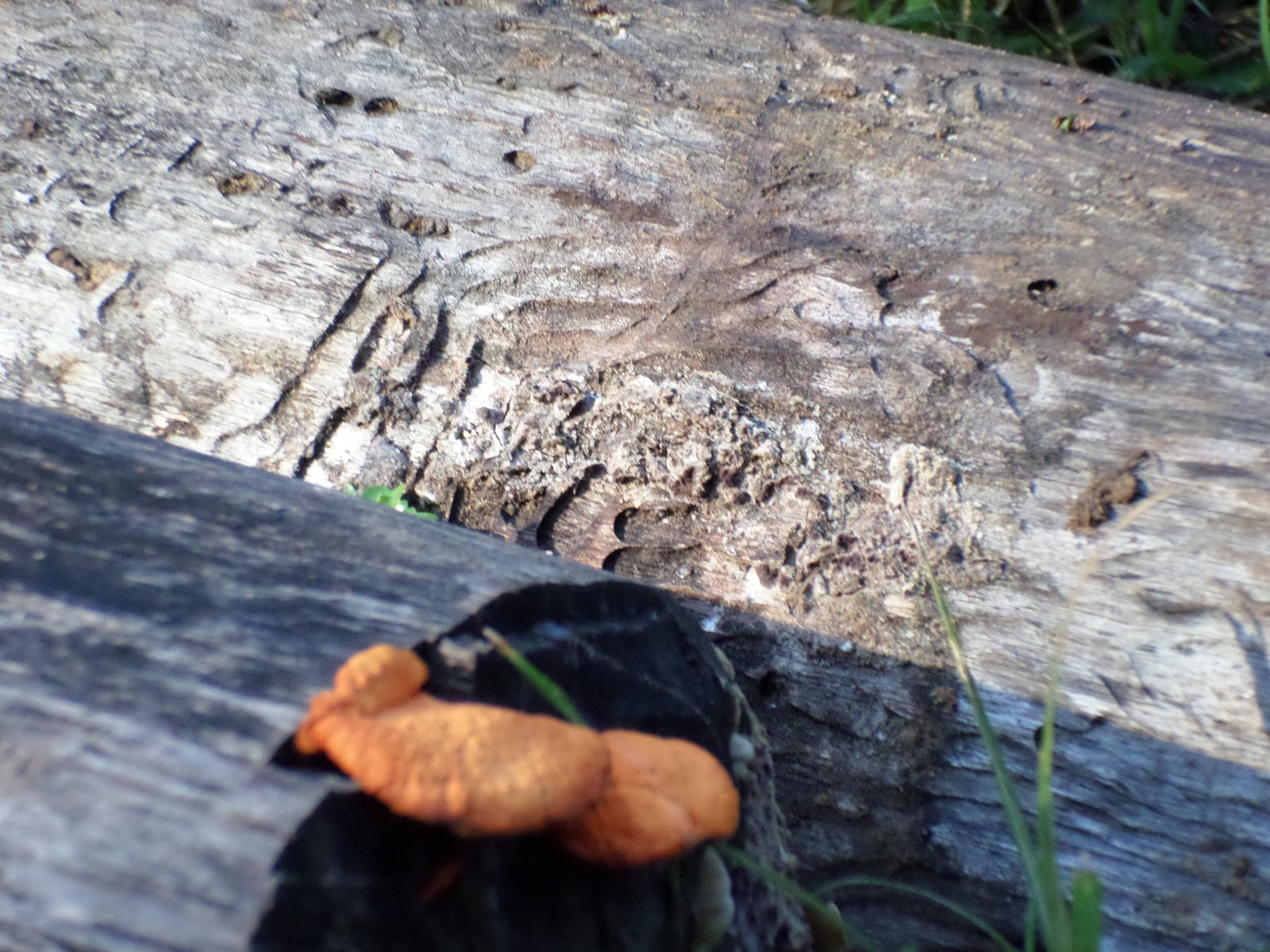
Orange fungi


Making my way back to the house, I came to the footbridge David made out of felled logs. It was the first time I saw fungi growing on it - but in truth, it was the sunlight hitting the log which drew my attention to it. When I go on an early morning walk, the sun seems to direct my senses, and I can now understand why plants find the perfect spots to grow in nature. They are following the path of the sunlight too.

After admiring the fungi on the log bridge, I slowly crossed it and then looked up to see...


Our house on the hill


Our house was being bathed in the morning sunlight, and I knew that is where my next destination would be. It was nearly time for breakfast, and a warm hug from my family.


Thursday, July 3, 2014

A winter interlude

Being a nearly teen, Sarah can spend hours in her room at a time. But then she can suddenly appear again and do something spontaneous. Like volunteering to take her little brother outside. They like to sit on the grass together, taking in the sunshine. It must be a winter thing.


Three little garden gnomes


There's plenty of time during the school holidays, for cheeky smiles and plucking the lawn. Peter loves to pull the grass and throw it around. Sarah watches him quietly. Even the cat joins the circle of lawn appreciation.


Piggy in the middle


That is until Peter decides to get closer. He's really gentle with our cat, except when he starts screaming at her. It's a game. He screams and the cat runs - Peter then laughs. Muesli ignored him for the most part, until he got too close...


Hasta la vista, baby


She decided to take-up a more comfortable position, and looked back at her lawn plucking, and occasionally screaming, friend. When I saw them all together on the lawn, I just had to get the camera. A lovely winter interlude of distraction.