I've decided I'm going to tackle one room per week, in an attempt to organise them better. The only reason I'm doing this is to make working in these individual rooms, more efficient. Nowhere is this more important, than in the kitchen! It's the one room families use THE MOST, because it contains the most storage areas, and the most electrical equipment, per square metre.
It also happens to be the hearth of our family's nutritional requirements. Making equipment readily available, therefore, is important. Especially when cooking a lot of things from scratch, or you're simply busy, and need to work fast.
Saturday 7 January - Day 1
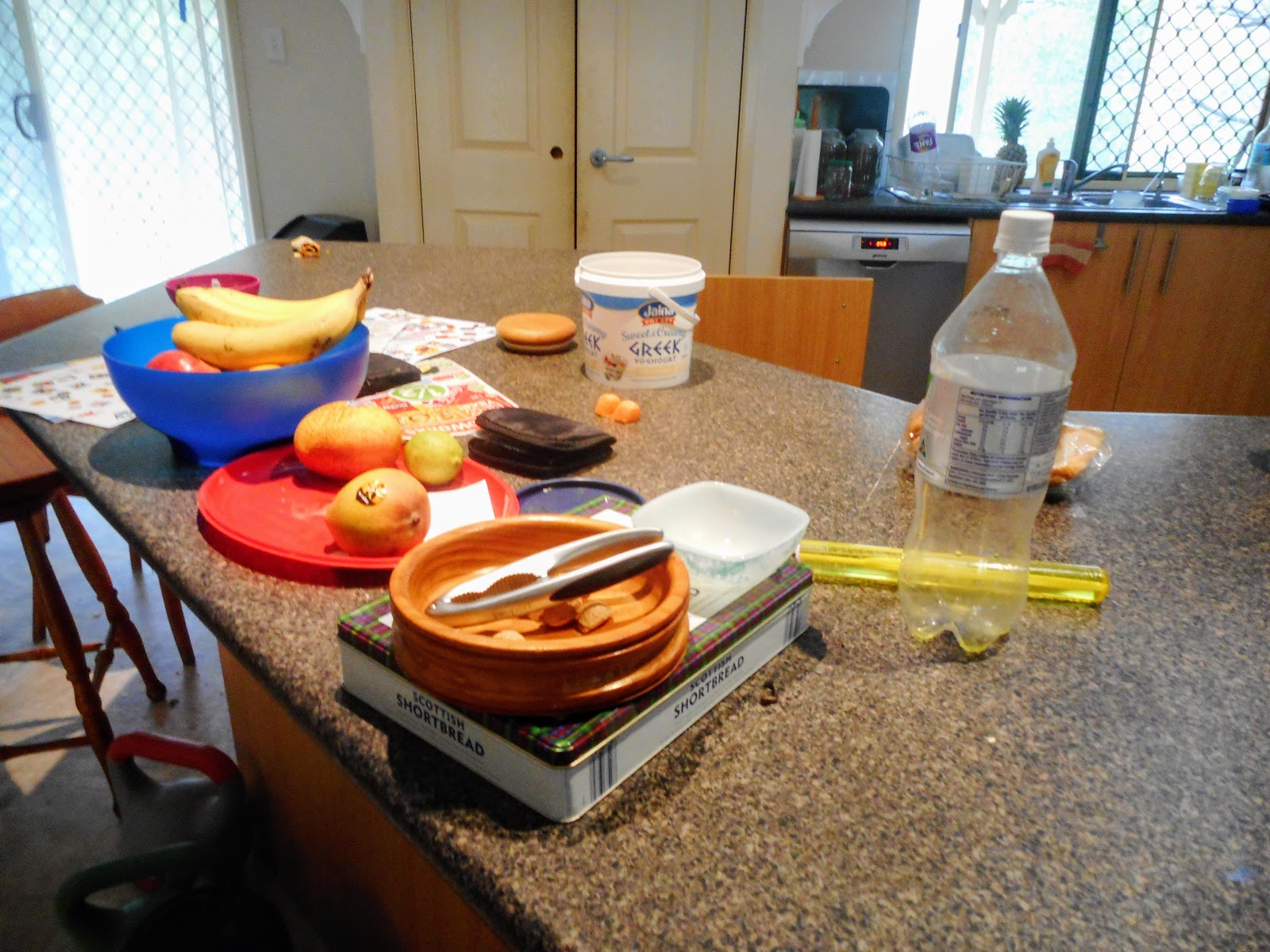
This is our kitchen in all its unflattering glory. The island bench, doubles as a breakfast bar, and the area my son regularly likes to get creative with his stickers and colouring books. This may always be the case, but there are many things in this kitchen which can be organised better.
I started with one cupboard, and thought I would progressively work through each one. But as part of the sorting process, I inevitably ended up in other cupboards too. I suspect this is how it's going to work throughout this room.
Before
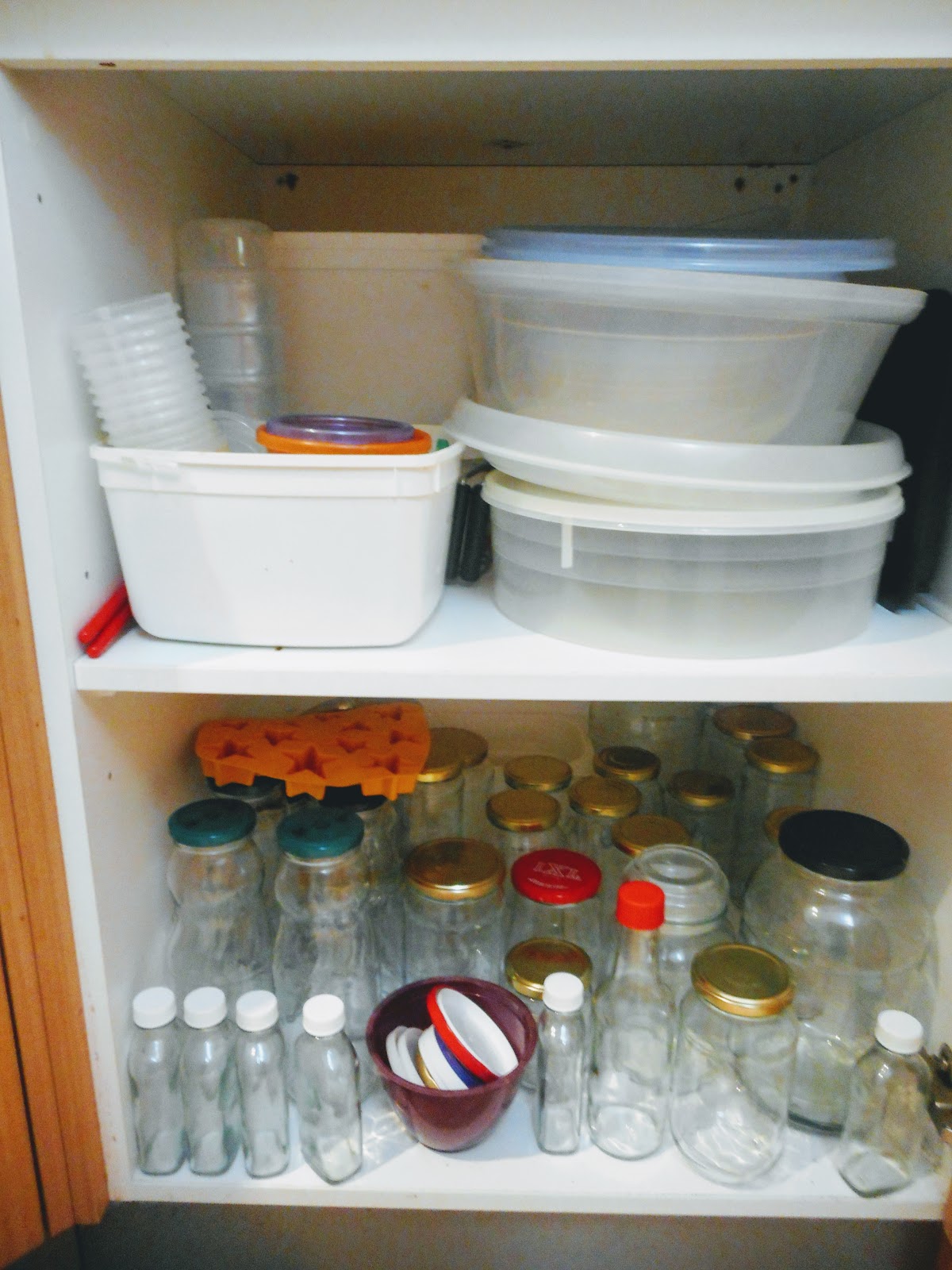
This is my plastics and extra jars (for preserving) cupboard. This has already seen a cull a few years ago. It looks neat enough, but still not fun, pulling out items, just to reach the ones at the back. I'm always wondering if I'm missing something back there too.
It was easy enough to make decisions about what would go, in the beginning. First, get rid of all the lids from the containers which broke, or have simply gone missing. Second, get rid of all the things I don't really use. I've lived here ten years, and never used some of the items in the back. So they were easy enough choices to make.
Where it started to get harder though, was deciding what items I do use on a regular basis. Should any of those be culled? I had to go there, to answer that particular question.
Cookie cutters
I have a small collection of cookie cutters which I store in a dedicated plastic container. I don't use them regularly, but enough that I'd hate not having the option to use them. Especially at Christmas when I make my Gluten Free Gingerbread men.
But I had THREE gingerbread men cutters. The one in the picture is the medium size. I don't remember ever using this cutter though. It could find a new home, where they don't possess a gingerbread cutter at all. The other two plastic cutters I don't remember using either. Because I have a metal range which have a similar shape, but more appealing florets. So I always end up using those.
It was time to cull these three, from my collection, in order to migrate other cooking supplies into the same container. Sounds simple in summary, but involved quite a lot of evaluation through the process.
Glass jars
The other problem I had was deciding which preserving jars could go. They all had new lids, and the ones above, I intended to keep for when I grew an excess of asparagus or other long, root vegetables. Only my garden has never produced any of those, let alone an excess. Plus, I'd need a pressure cooker to preserve low acid foods, such as vegetables. I couldn't see me buying one of those soon.
By evaluating what I needed now, and used MOST (500ml and smaller) I could cull the others. It was a hard decision to make though. I didn't have a lot of tall jars (more than in the picture) but it was still saying goodbye to something which could one day, be useful. By getting rid of these jars however, I've made the jar cupboard a lot more accessible for the jars I DO use a lot of.
Fermenting Kombucha
These 2 litre jars, recycled from my husband's work, get used for making Kombucha and fermenting fruit peelings for vinegar. They can now be housed in my jar cupboard, rather than taking over the pantry to be stored. Even still, I had to cull these very useful (used regularly) jars too.
Organising for more efficiency, has become an exercise in deciding what level of excess is productive, and what level is collecting dust and taking up energy in the kitchen. It becomes a chore to get past those "excesses", when you'll never really use it all. While someone is going without, and
could use it. So evaluate what you can realistically use, and pass on the rest to new homes.
On that note, if there are any locals who want some extra jars, just leave a comment.
Practical, or is it?
Another item stored in my plastics cupboard, was ONCE a much used item. I purchased this cake holder, to store muffins, cookies and cake, many years ago. It would see the top of my kitchen counter, quite often - or cart goodies to the local playgroup, or some outing where they were required. Then something unexpected happened...
...I was given a more durable metal cake holder, from my In Laws, one Christmas. I didn't realise it, until I sorted through the plastics cupboard, that my once prized, cake holder, was no longer being used.
So that particular item will find a new home too. I have two cake holders in my house. Someone else, deserves the chance to own one. It's been kept in good condition and will be snapped up quickly at our local 2nd-hand shop.
After
I have a lot more space in my cupboard now it's been efficiently culled. What items I do have to remove now, to reach the back, are now less cumbersome. The fact I will use those items in the back regularly too, means I'll always know what's there. I didn't put anything back, which I don't use regularly. Efficiency requires, I use what I have and don't waste energy on what I don't use.
Like I said at the beginning though, tackling this cupboard, inevitably meant I ventured into other parts of the kitchen too.
Pantry - note the red apron
My pantry looks neat enough, but they're deep shelves and getting to the things in the back, requires a lot of double handling - because I have to remove the items at the front. This will always be the case, especially when I like to stockpile a few items we use the most.
I knew there were a few small improvements I could make however. Which all came about, through organising my first cupboard.
Using what I already had
I had previously stored my sachet packets (spices and samples) in those large green baskets. They were always falling over, every time I removed something larger from the basket. Plus extra packs of oats, crackers and wraps would always end up on top of those baskets - making accessing the tiny sachets underneath, a pain.
I found the clear plastic container, tucked in the back of my plastics cupboard. I think it was from an old fridge, which is now long gone. It's the perfect dedicated space, for the smallest items in my pantry. Which makes writing the shopping list more efficient too. I can now see what I have enough of and what needs replacing. I love my spices, for cooking delicious food!
Avoiding empty spaces
I also emptied all the excess packets from the pantry, into some of the empty jars I keep cooking ingredients in. Removing packets from the pantry, means there's less stuff to sift through, when finding items at the back.
There was one more thing I did however, to make organising, and accessing my pantry easier.
Out of the way
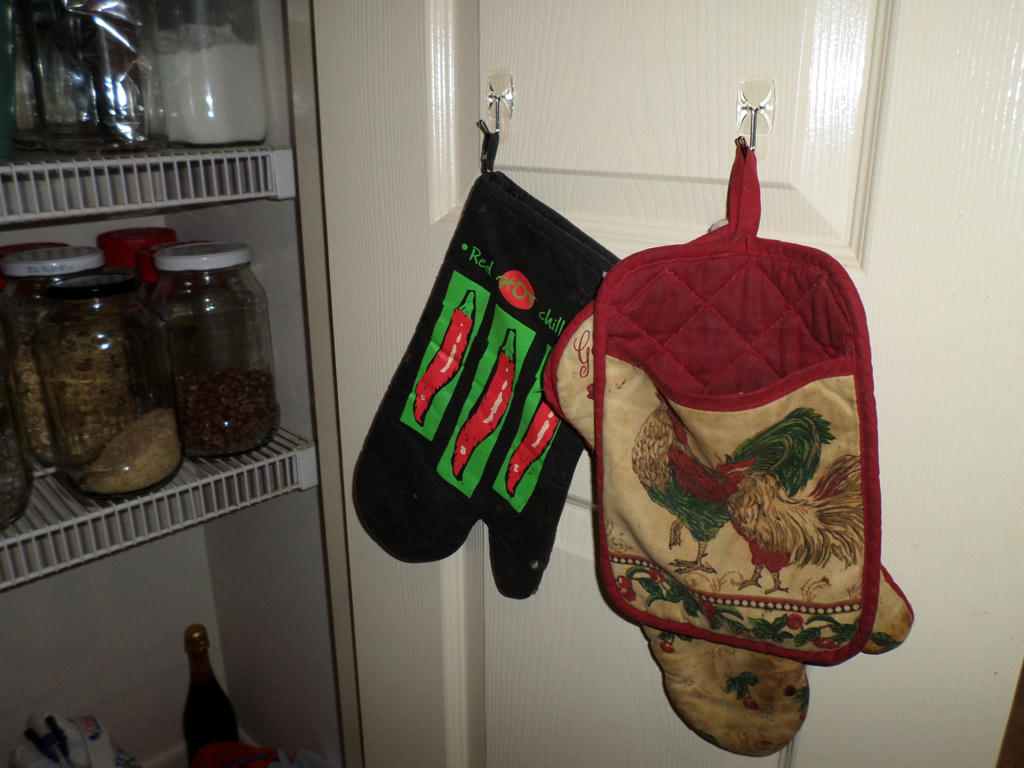
Remember how I stored the red apron, in the middle of the pantry shelves? It was annoying having to flick that thing out of the way, to see my ingredients. It was a simple matter of finding another adhesive hook though, like I used in
this former kitchen storage post.
Oven mitts on hooks
The aprons (yes, they've multiplied) are now positioned opposite the oven mitts, inside the pantry doors. Aprons, oven mitts and a pantry of ingredients. Much more organised. Of course, there's always more I can do, but this was enough for one day.
There was another development which
eventuated from the pantry improvements, however. A small, but handy solution.
Keep it together
As I sorted through the ingredients in the pantry, I found an old Muffin Cases container. I was using it to store smaller patty pans in. Those patty pans had been sitting there for years. I prefer Muffin cases (larger) now. So I discarded the few patty pan cases, and had a better use for the container.
In my drawer, where I store a few things like greaseproof paper, and markers for writing dates on preserves and fridge leftovers - I also had an assortment in the back, that were always moving up and down the drawer, whenever I opened it.
There were things like bottle caps (for re-corking glass bottles) coffee scoops and clips that came with the kid's drink bottles, but they don't like. I keep them in case they will ever come in handy. Small containers, within cupboards or drawers, make storing smaller item, easier. They don't end up migrating into the larger space. You also pull the whole container out to find your items. Pour them onto the bench to sort through.
I hope I'll have more progress to share, by next Saturday - when my week's up!